
A Book Should Earn Its Length
I do not believe every idea deserves a book.
Some ideas are complete in a paragraph. Some belong in a conversation, a short article or a fifteen-minute talk. Stretching them into chapters does not make them deeper; it only makes the reader travel farther for the same answer.
A book begins for me when the question keeps widening. What looked simple starts revealing layers: personal choices, relationships, habits, language, consequences, contradictions and the gap between what people say they value and what they repeatedly do.
At that point, the subject has earned more room.
The first responsibility of an author is therefore not to ask, 'Can I write a book about this?' It is to ask, 'Does this subject require a book, and what will the reader understand, recognise or do differently because I asked for this much of their time?'
A book should earn its length.
I Write Toward the Gap Between Intention and Practice
Most of the subjects that draw me share one tension: people often know more than they consistently practise.
We know words matter, yet we speak carelessly when tired or angry. We say relationships require attention, yet assume love will maintain itself. We understand that meaningful work requires action, yet wait for motivation to become perfect. We say responsibility should be shared, yet allow invisible labour to settle repeatedly on the same person.
Information alone rarely closes that gap.
The reader usually does not need another command to 'communicate better', 'be disciplined', 'love more' or 'work harder'. Those instructions are too large and too familiar. A useful book must move closer.
What does better communication sound like when a conversation is already tense? What structure helps when motivation disappears? What behaviour makes shared responsibility visible? What sentence should be reconsidered before it becomes another person's inner voice?
The work of a book is to turn a value into something the reader can recognise in ordinary life.
I write toward the distance between what we mean and what we repeatedly make real.
The Questions Behind My Books
That pattern is visible in the books I have chosen to write.
Oh! Marriage* grew from asking why sincere love does not automatically produce an intentional marriage. *The Will Loop* came from the distance between knowing what matters and consistently doing it, especially after motivation fades or life interrupts. *The Chore Myth* began with a household contradiction: people can believe in fairness while invisible labour keeps settling on the same person. *A Life Shaped by Words* asks how spoken words become memory, identity, relationship and legacy.
These books are not one argument repeated under different covers. Each enters the gap from a different door. But the impulse is related: familiar advice is not enough when the underlying pattern remains unnamed, unexamined or difficult to practise.
The title usually arrives after the question has shown me the work it demands.
I Begin With a Tension, Not an Easy Villain
The questions that interest me usually resist easy villains.
The problem is rarely that one person knows nothing and another knows everything. More often, people are living inside habits, expectations, words and systems they have never fully examined.
That is where I want to write: the moment something ordinary becomes visible enough to question - the promise repeatedly postponed, the joke that diminishes someone, the marriage sustained by assumption rather than intention, the chore nobody notices because one person always completes it, or the phrase a child begins to believe about herself.
A book gives me room to ask not only what is happening, but why it keeps happening and what a more intentional alternative might require.
The Reader Is Not a Container for My Thoughts
Writing can become self-indulgent very quickly.
An author may have fifty reflections, twelve stories and several arguments that all feel important because they belong to the author. The reader does not owe them equal attention.
The reader has made an exchange: time and concentration in return for clarity, recognition, challenge, companionship or a useful way forward. That means selection matters.
A story belongs because it illuminates the subject, not merely because it happened. A quotation belongs because it sharpens the argument, not because it sounds wise. An exercise belongs because it helps the reader think or act, not because every chapter needs an activity.
One of the hardest disciplines in writing is removing something good because it is not serving the book.
The manuscript becomes stronger when the author stops asking, 'Do I like this passage?' and begins asking, 'What work is this passage doing for the reader?'
The reader is not a container for everything I have thought.
Craft Must Serve the Question
Frameworks, stories and revision are tools. None of them is proof of depth by itself.
A framework earns its place when it helps the reader name a pattern, remember a sequence or make a better decision under ordinary pressure. It should reduce confusion rather than make the author's terminology more visible. A good framework is a handrail, not a cage.
A story earns its place when it reveals cost, contradiction or consequence in a way explanation alone cannot. An author may tell her own experience, but she does not automatically own every detail of another person's life. Privacy, consent, accuracy, proportion and dignity still matter. Truthfulness is not the same as exposure.
Revision tests whether these tools are serving the question. It exposes the repeated metaphor, the chapter that circles an earlier insight, the explanation that arrives too late and the certainty that should have made room for complexity.
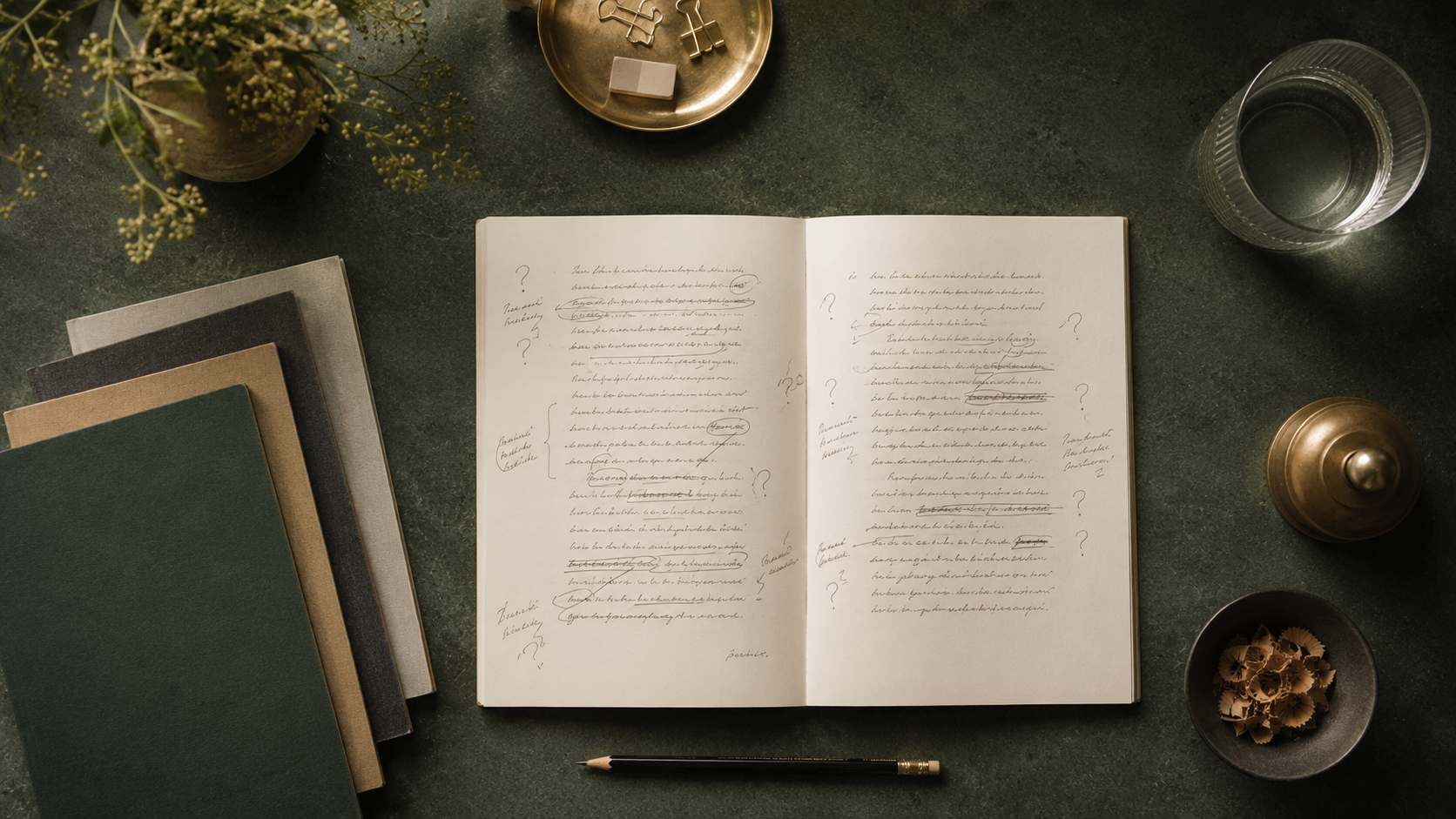
The first draft creates material. Revision decides what belongs.
Writing creates material. Revision creates the book.
I Want the Book to Continue After the Last Page
A book is finished physically when the reader reaches the final page. Its real work may begin afterwards.
The test I care about is not whether every reader agrees with me. I want the book to leave a better question in the room.
Perhaps a couple notices an assumption they have never discussed. A parent hears the weight of a phrase before speaking it. A reader who has postponed something meaningful chooses one honest action. A family notices who is carrying the invisible work. A professional recognises where a rule, habit or decision needs to be examined.
These are modest outcomes compared with the dramatic promises books sometimes make. I prefer them.
A book cannot control a reader's life. It can offer language, structure, perspective and a place from which a different choice becomes easier to see.
The book has done meaningful work when the reader closes it and becomes more capable of noticing what should happen next.
A Behind-the-Book Audit
Think about a book, article, course, speech or other body of work you are considering creating:
- What question is large enough to justify the reader's time?
- What tension or recurring problem makes this subject worth examining?
- What does the reader already know that I do not need to repeat?
- What should the reader understand, notice or do differently by the end?
- Which stories genuinely advance the work, and which merely decorate it?
- Does every framework clarify something practical, or is it branding without added value?
- Where am I repeating myself because I am attached to the language rather than the idea?
- What personal material requires greater privacy, consent or restraint?
- What would I remove if I were editing entirely in the reader's interest?
- What question or action should remain after the final page?
The purpose is not to make writing mechanical. It is to make the author accountable to the work the reader has been promised.
The Book Begins Before the First Chapter
By the time I begin shaping chapters, much of the real decision has already started.
I am deciding what the book is for, what it is not for, whose problem it is trying to illuminate, what evidence or lived understanding it can responsibly carry, and what kind of change it has the right to invite.
The title matters. The cover matters. The launch matters. None of them can rescue a book that has not decided what work it is trying to do.
That is why I write the books I write.
I write when a question keeps asking for a larger room - and when I believe I can build that room carefully enough for a reader to enter, examine something honestly and leave seeing the next step more clearly.
A book begins when the question earns the space.
It becomes worth publishing when the author has disciplined the work enough to deserve the reader's time.
A Closing Reflection
A book should not merely contain an author's ideas. It should organise a question so carefully that the reader can think more clearly, notice more honestly and act more intentionally after leaving it.