Every Meaningful Life Is Built Twice
Long before a cathedral rises above a city's skyline, it exists in the imagination of someone who believes it should. The architect sees what no one else can yet see. The mason lifts stones that appear insignificant on their own. The carpenter shapes timber that will eventually disappear beneath the finished roof.
For months, sometimes years, the building remains visibly incomplete. Passers-by see scaffolding, dust and unfinished walls. Some wonder whether the effort is worthwhile. Others lose interest because the beauty is not yet visible.
Those who understand the work know something different: a cathedral is never built in one magnificent day. It rises through thousands of ordinary days, each entrusted with one part of the design.
Our lives are built in much the same way.
We often wait for one extraordinary moment to change everything: a surge of motivation, the perfect plan, a quieter season, a day when discipline will finally feel effortless. Life rarely cooperates with that expectation. More often, the future arrives quietly, disguised as an ordinary Tuesday, and asks a question that seems almost too small to matter:
Will you honour today's stone?
Not the entire cathedral. Just today's stone.
Motivation matters. It can awaken desire, clarify possibility and give us courage to begin. But motivation is a spark. A spark can light a fire; it cannot keep the fire burning through the night. That requires attention, fuel and the willingness to tend what was started after the excitement of the first flame has disappeared.
Motivation may lay the first stone. It cannot build the cathedral.
The Promises No One Else Hears
There are promises we make before witnesses: wedding vows, professional oaths, public commitments and words spoken at important family moments. These promises matter because they shape our relationships with other people.
But there is another kind of promise that receives far less attention: the promise made when no one else is listening.
I will become healthier.
I will finish the book.
I will become more patient with my family.
I will stop postponing the work I know I have been given to do.
These private promises may never be applauded or recorded, but they shape one of the most important relationships we have: the relationship with ourselves.
Every time we honour one, self-trust quietly grows. Every time we repeatedly abandon one, doubt learns our habits. This is not an invitation to shame ourselves. It is an invitation to notice that identity is always listening.
Every promise kept leaves a fingerprint on the person we are becoming.
We do not become trustworthy by making impressive promises. We become trustworthy by quietly keeping ordinary ones.
When Ordinary Life Enters the Room
Our culture is fond of beginnings. We celebrate the launch, the announcement, the resolution and the first brave step. Far less attention is given to the quiet work that follows, when inspiration has become responsibility and ordinary life has entered the room.
There have been seasons in my own life when several responsibilities seemed to ask for me at once. The law demanded precision. Public service demanded accountability. Motherhood required presence. Marriage required attention. Writing asked for stretches of quiet that the day did not always offer willingly. Faith invited trust when certainty would have felt easier.
These responsibilities did not queue politely. None was unimportant, and none deserved a careless version of me.
For a long time, I imagined that consistency belonged to people whose lives were somehow less complicated. Perhaps they had uninterrupted mornings, fewer obligations or unusual reserves of energy. I expected faithfulness to become easier when life became quieter.
Life did not become quieter.
What changed was my understanding of consistency.
Consistency is not a life without interruption. It is a life that knows how to return after interruption.
Ordinary life is not the enemy of meaningful purpose. It is the place where purpose must learn to take practical form. The question is not, When will life finally make room for what matters? The better question is, How will I carry what matters while life remains real?
Walking Taught Me What Intention Means
Some of life's clearest lessons arrive wearing ordinary clothes. One of mine came through walking.
I knew I needed to become more physically active. The benefits were clear. The intention was sincere. Knowledge was not the problem, and neither was desire. The gap lay somewhere between knowing and doing.
Tomorrow became a convenient hiding place. There was always one more email, one more responsibility, one more reason today's walk could wait.
Then, on an ordinary morning, I became tired of negotiating with myself. I did not make a dramatic declaration. I simply put on my shoes and went outside.
That first walk did not transform my health overnight. It transformed the evidence.
Yesterday contained intention. Today contained action.
As the practice developed, I discovered that the promise did not always have to be carried in the same form. On some days I could complete the full distance at once. On others, real life required me to divide it: two kilometres in the morning, another kilometre later and the remainder in the evening.
The arrangement changed. The promise remained alive.
That distinction became one of the earliest stones in what I later called The Will Loop. I began to understand that transformation rarely starts when we finally feel like different people. It starts when we choose to leave different evidence behind us.
The First Honest Move
Most people do not postpone meaningful work because they are incapable. They postpone it because they imagine the whole journey before taking the first step.
A manuscript becomes a completed book before a paragraph has been written. A healthier life becomes an ideal body before one walk has been taken. A restored relationship becomes years of healing before one honest conversation has begun.
The imagination unintentionally turns tomorrow into a mountain.
The Will Loop begins somewhere smaller. It begins with what I call the First Honest Move.
This is not the smallest symbolic action designed merely to make us feel productive. Rearranging files is not writing. Talking repeatedly about a difficult conversation is not having it. Buying equipment is not the same as beginning the practice for which it was purchased.
The First Honest Move is the smallest action that genuinely changes reality.
Sometimes it is one considered paragraph. Sometimes one telephone call. Sometimes one apology offered without an immediate defence. Sometimes it is simply putting on your shoes and walking through the front door.
A compass can point. It cannot walk.
The power of the first move is not its size but its truthfulness. Yesterday contained only intention. Today contains evidence.
The Evidence Ledger
My years in law taught me that a claim is not strengthened by repetition. It is strengthened by evidence. Eventually, I began applying that discipline to the promises I made to myself.
At the end of a day, I no longer ask only, Did I perform perfectly? I ask a more useful question: What evidence did I create today?
One page written.
One difficult decision made.
One promise honoured.
One walk completed.
One conversation entered with greater patience than before.
I think of this private record as an Evidence Ledger. It is not a public performance, a perfection scorecard or a way of pretending that small actions are sufficient forever. It is an honest account of participation.
Discouragement has a remarkable memory for failure and a poor memory for faithfulness. It can recall every interruption while dismissing every return. The Evidence Ledger restores balance. It reminds us that growth may be quiet without being imaginary.
Evidence makes self-trust less dependent on mood.
We do not need to keep announcing the people we hope to become. We can quietly collect proof that we are learning to live as them.
The Return Principle
No meaningful life escapes interruption.
Children become ill. Work expands unexpectedly. Travel disrupts routine. Energy disappears. Grief visits without invitation. Sometimes the arrangement that once supported us no longer fits the season we are living.
The danger is not the interruption itself. The danger is allowing an event to become an identity.
I missed three days is a fact.
I never finish anything is a verdict.
We must learn not to confuse the two.
The Return Principle offers a more truthful response. It asks us to return without contempt, examine what interrupted the practice and decide whether the promise should be resumed, resized or relocated.
A missed day is a fact, not a verdict.
Returning is not evidence that the method failed. Returning is one of the methods.
Sometimes return looks unimpressive: reopening the manuscript, taking the next walk, making the call, or beginning the conversation again with a better tone. But the person who learns how to return is more resilient than the person whose plan has never yet been tested.
A life of intention is not a life that never drifts. It is a life that knows how to correct its direction.
Discipline Is a Form of Kindness
Discipline has acquired an unfortunate reputation. It is often presented as severity, punishment or an endless struggle against ourselves.
I have come to think of discipline differently.
Discipline is the kindest letter we write to our future selves.
Every promise honoured today becomes a sentence that tomorrow will quietly read. It says, Your future mattered enough for me to act before the outcome was visible.
True discipline does not make us cruel to ourselves. It protects important decisions from temporary moods. It refuses to make tomorrow carry every promise that today repeatedly postpones.
But discipline must be joined to wisdom. Discipline without wisdom becomes rigidity; rigidity can mistake exhaustion for laziness and genuine limitation for excuse. Wise discipline asks what faithfulness honestly requires in the circumstances that exist, not in the conditions we wish we had.
When we practise discipline in this way, we are not becoming harder on ourselves. We are becoming more trustworthy to ourselves.
Carry the Promise
Life will not always permit the ideal version of a plan. That does not mean the value behind the plan must disappear.
There are seasons when the chapter becomes one paragraph, the hour becomes twenty focused minutes, and the complete repair of a relationship begins with one question asked without accusation.
The promise is not reduced into meaninglessness. It is resized so that its purpose can survive real conditions.
Rigid plans can break. Living promises bend without losing their direction.
Adaptation is not surrender. It is wisdom carrying purpose through real life.
Perfection often postpones because it would rather protect the ideal image of the work than risk an imperfect performance. Faithfulness is less concerned with appearance. It wants the work to remain alive.
Carry the promise. Change the route when necessary. Protect the value. Leave honest evidence.
The Person Your Habits Are Introducing
Every day, our habits introduce us to our future selves.
One action does not settle an identity, just as one stone does not make a cathedral. But repeated actions gradually become an architecture. They shape what we trust ourselves to do, what others learn to expect from us and what our private lives contribute to our public words.
A page written today may not become a book tomorrow. One honest conversation may not transform a marriage overnight. One walk does not create lifelong health. Yet each faithful decision becomes another stone in the structure.
People may eventually admire the finished building. God, conscience and time have witnessed the daily stones.
The world often notices achievement. Character is formed in the cultivation that preceded it.
This is why the quiet decisions matter. The decision to tell the truth when concealment would be easier. The decision to return after embarrassment. The decision to honour a relationship through everyday attention rather than occasional display. The decision to continue meaningful work when no audience is waiting.
Trust grows when our private conduct supports our public words.
Begin With Today's Stone
There is a sentence I have learned to distrust: I will begin when I am ready.
Preparation matters. Readiness has value. But readiness can also become a respectable disguise for fear. We wait for uncertainty to disappear, for confidence to arrive fully formed, or for the first attempt to look like the finished work.
Courage does not require certainty. It requires a decision about what matters more than uncertainty.
The first draft may be awkward. The first conversation may not resolve everything. The first walk may feel disappointingly ordinary. That does not make the beginning insignificant. It means the work has finally entered reality.
You do not have to recover every lost day before taking the next faithful step. Life does not ask you to rewrite yesterday. It asks you to respond to today.
Do not measure your future against your regret. Measure it against your next honest move.
Five Reflections for Today
Pause before continuing with your day and consider these questions:
1. What important promise have I quietly postponed?
2. Am I waiting for motivation when I should be creating structure?
3. What is the First Honest Move available to me today?
4. If life interrupts the plan, how will I return without turning the interruption into an identity?
5. What evidence do I want today's choices to leave in the person I am becoming?
Do not rush the answers. The quality of our lives is often shaped by the quality of the questions we are willing to ask repeatedly.
The Cathedral Is Built in Ordinary Days
One day, someone will meet the person your ordinary decisions are creating.
It may be your child, your spouse, a colleague, or a reader who encounters your words long after you have written them. It may simply be the older version of yourself looking back across the years.
When that meeting comes, may you recognise the quiet beauty of a life that was not built by waiting for extraordinary days, but by honouring ordinary ones.
Cathedrals do not endure because one stone was extraordinary. They endure because ordinary stones were placed faithfully, each accepting its part in a design larger than itself.
So begin with today's stone.
Tomorrow will ask for another.
Motivation has already done its work: it showed you possibility. Now let intention do the quieter work of making possibility visible.
Continue the Journey
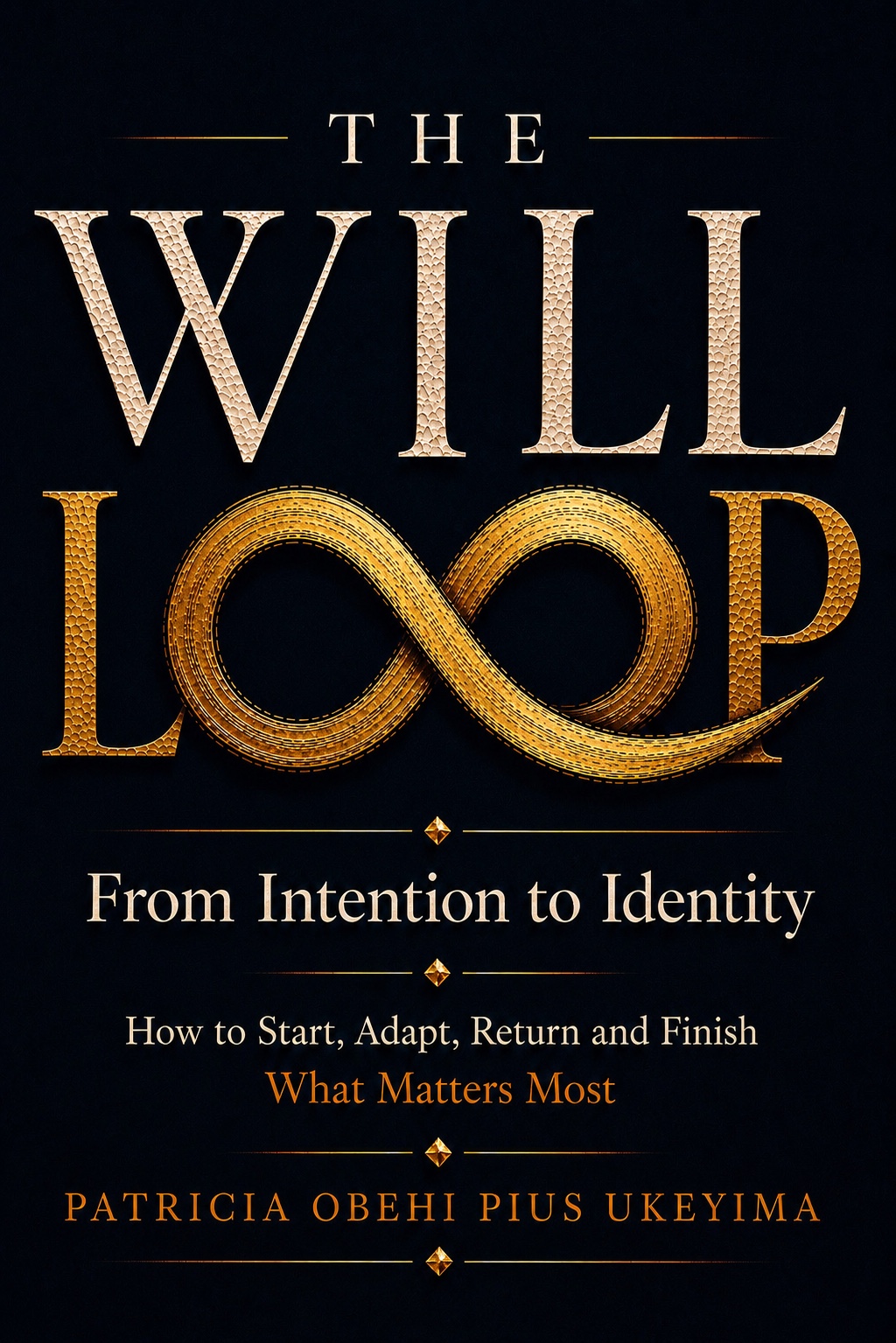
In The Will Loop: From Intention to Identity, Patricia Pius Ukeyima develops a practical framework for appointing a promise, making the First Honest Move, carrying it through real conditions, keeping evidence, returning without self-contempt and finishing what matters. The invitation is not to become perfect. It is to become faithful.
A Closing Reflection
Every promise kept leaves a fingerprint on the person you are becoming. Honour today's stone. Return when life interrupts. Keep building.
Patricia Pius Ukeyima Lawyer | Author | Speaker | Mentor Love Intentionally. Live Intentionally. Grow Intentionally.