Education Is Larger Than School
School gave me letters, numbers, books and the disciplined possibility of a different future. I do not diminish that gift. Every child deserves safe, equitable access to quality education.
But not every important lesson waited for a classroom. Some sat on low benches in other people's compounds. Some appeared in ceremonies, disagreements, repairs and the way an elder entered a grieving house.
Insight No. 17 examined what early work taught me. This essay asks a wider question: what did place, observation, custom and community life teach when nobody announced that a lesson had begun?
Education is not only the transfer of information. It is also the formation of judgement.
It teaches us what to notice, how to enter another person's space, when to speak, what to repair, whose burden matters and whether knowledge makes us more useful or merely more certain.
Learning How to Enter and Observe
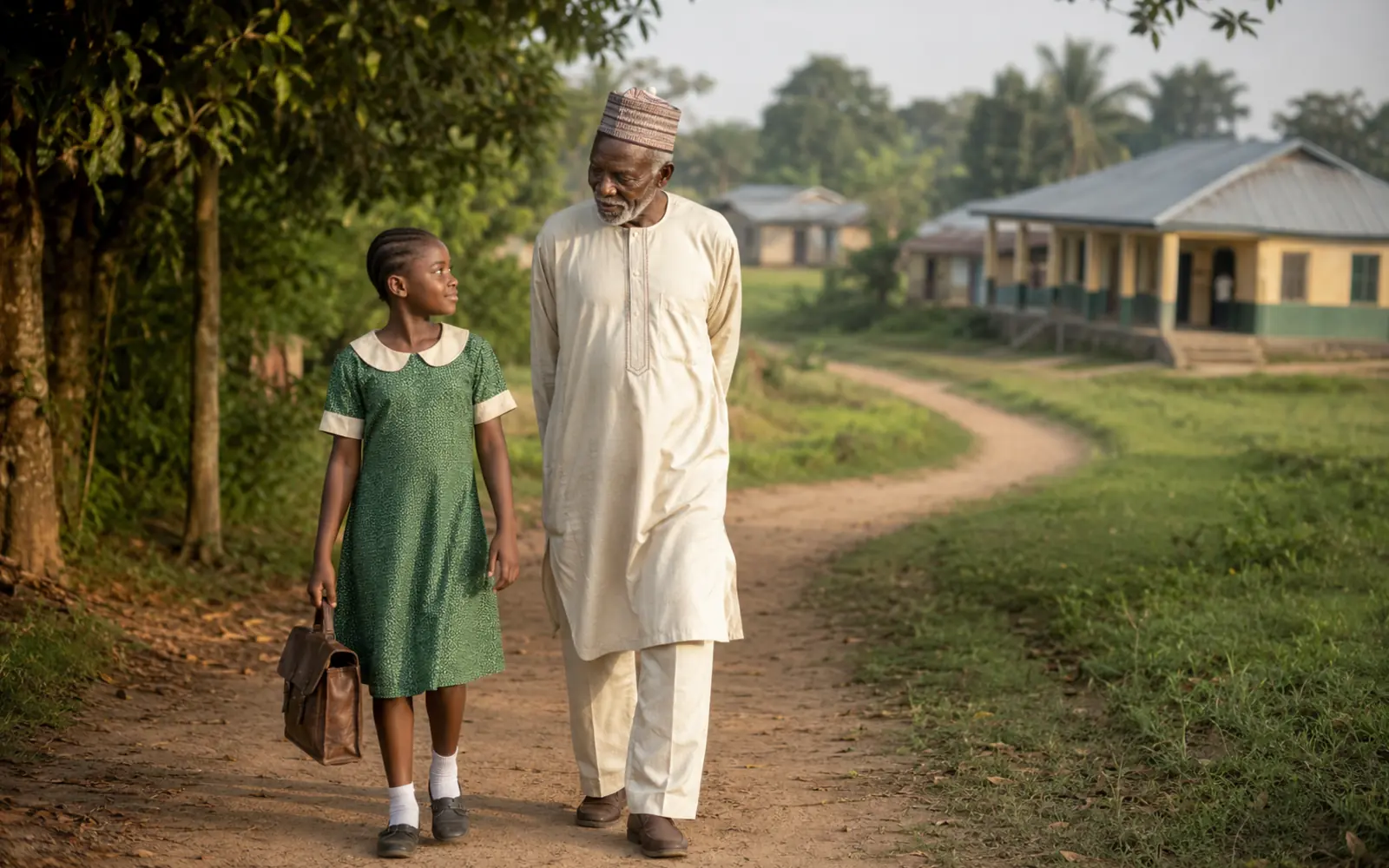
During festival season, Grandfather would wake early and say, "Get your slippers." He rarely explained the whole destination. The lesson was partly in going.
He carried a small bag containing kola nuts, dried fish, groundnuts, palm oil or leaves intended for someone's body. More importantly, he carried names, obligations and a way of greeting that used two hands and the right amount of silence.
I followed at first believing that we were simply visiting. Yet each compound required a different pace. In one, laughter arrived before water. In another, grief sat so close to the doorway that even a child could feel the need to lower her voice.
He did not scatter greetings. He placed each one where it belonged and waited for the response.
From him I learned an unwritten rulebook: enter after elders; receive hospitality without insulting what is offered; speak when words add calm; sit quietly when presence is more useful than explanation; leave an elder's house with at least one sentence worth remembering.
These were not rules of performance. They were forms of social intelligence.
Manners taught me that another person's home had a history before I entered it. Respect was not shrinking myself. It was arriving without behaving as though my appetite, volume or schedule were the centre of the room.
Observation trained attention before I had language for analysis. I began noticing who was interrupted, who was thanked, whose labour remained invisible and which apologies repaired rather than merely ended a quarrel.
Grandfather also taught through attention. He listened to a person's full account before advising. He did not hurry grief or treat silence as failure.
Children learn from what adults repeatedly do, not only from what adults formally teach. The question is therefore not simply, "What have I told them?" It is, "What has my conduct made believable?"
Learning How to Help and Judge
On the way to Edenu, a boy passed us with a damaged wheelbarrow carrying cassava. Grandfather set down his bag, cut a strip from an old inner tube and secured the wheel well enough for the boy to continue.
"It will take you home," he said. "Not to market."
That distinction stayed with me. Help should be honest about what it can and cannot do.
The boy tried to offer groundnuts in gratitude. Grandfather refused payment. Even that exchange taught me that help can preserve another person's dignity without turning kindness into a performance.
Temporary relief matters. It should not be presented as permanent repair. Practical compassion notices the burden, uses what is available, reduces immediate harm and speaks truthfully about what remains unsafe.
Grandfather carried the same discipline into a boundary dispute in Ileh. Two men had drawn competing lines in the dust. He listened, inspected the path and proposed a line that protected shared movement rather than completely rewarding either claim.
"This path belongs to footsteps, not men," he said. "You may own a mound. You cannot own a movement."
The lesson was not that every dispute has a simple village answer. It was that judgement must examine the life surrounding a private claim.
Grandfather did not begin with a speech. He began with listening and inspection. The disputed ground had to be seen before anyone's certainty could be trusted.
Evidence entered where accusation had been shouting.
Formal law remains essential because custom can be inconsistent, unequal or coercive. Yet legal judgement is strengthened when it remembers the people, relationships and consequences hidden behind a case name.
Learning What to Carry and What to Question
One morning Grandfather handed the bag to me. No speech. Its leather smelled of sun and time.
"Don't drag it," he said. "It is not firewood. Let the bag know you are a person, not a hook."
At an elder's house, I received a blessing: "Your feet will remember your name." On the way home, the bag felt lighter because I had learned how to carry it.
The lesson was larger than posture. What we inherit must be carried with awareness, not dragged without thought.
A naming ceremony taught the same principle. Palm oil, salt and water represented different tastes of life. Names joined a child to history, hope and responsibility.
At the ceremony, the prayer asked that the child's mouth learn sweetness without forgetting truth, that her hands remain busy without becoming cruel and that her feet find home from far places. Ceremony made values memorable by giving them symbol, rhythm and witnesses.
Festival life taught belonging through preparation, celebration and restoration. The morning after music, people returned with brooms, rakes and the duty to leave the field in order.
Community practices can hold memory, hospitality and mutual care. They can also preserve hierarchy, exclusion or silence.
Not every practice deserves protection merely because it is old. Tradition should be tested by whether it supports dignity, safety, truth, equality and the flourishing of those with the least power.
Culture is strongest when it can carry memory without demanding silence about harm.
Books and Life Must Educate Each Other
There is danger in romanticising education outside the classroom.
A child may learn resilience on a difficult route and still deserve a safer one. Village wisdom should never excuse poor schools, unequal access, child labour, unsafe infrastructure or the exclusion of girls and children with disabilities.
Practical knowledge is not a consolation prize for people denied formal opportunity.
Children deserve both: classrooms that develop literacy, numeracy, imagination and critical thought, and communities where knowledge becomes conduct, where elders listen, labour is respected, help is honest and power can be questioned.
Informal education can also be narrow. A community may confidently repeat what it has never tested. Formal study can introduce other histories, evidence, scientific methods, legal protections and voices that local custom has ignored.
Formal learning gives language, methods and wider access to knowledge. Lived experience tests whether those ideas can survive contact with real people.
The best education does not force a choice between books and life. It teaches us to bring disciplined thought into lived reality and lived reality back into the questions books ask.
What These Lessons Carried into My Profession
Years later, I could recognise Grandfather's small bag inside my professional habits.
Listening before judgement had become evidence gathering. Respectful entry had become professional courtesy. Naming the limit of a wheelbarrow repair had become responsible advice. Examining the shared path around private claims had become legal reasoning. Testing what custom protected, and what it could endanger, had become critical judgement.
The classroom taught me to read the law. The road helped me recognise the life the law was meant to serve.
Neither education was sufficient alone.
Knowledge becomes more trustworthy when it can move between principle and person, record and reality, authority and consequence.
Responsible judgement therefore requires more than knowing the rule. It requires asking who will carry the consequence, whether the proposed remedy can do what it promises and what remains unseen in the official record.
Credentials may open a door, but judgement determines how a person enters, what they notice and whether their presence leaves the room more just than they found it.
A Beyond-the-Classroom Audit
Think about the places and people that educated you outside formal schooling:
1. Which ordinary place taught me something I still use?
2. Who taught through conduct rather than explanation?
3. What did I learn about greeting, listening or entering another person's space?
4. Which practical skill taught me judgement rather than mere technique?
5. Where have I mistaken temporary help for a complete solution?
6. What community practice deserves to be preserved?
7. What inherited practice needs repair, challenge or release?
8. Whose knowledge have I undervalued because it was not formally certified?
9. What educational opportunity should I help protect or expand for someone else?
The purpose is not to praise everything learned outside school. It is to recognise where wisdom formed, test it responsibly and use it in service of a more humane future.
Let Every Teacher Be Accountable to Life
Some teachers hold chalk. Some carry a small bag, repair a wheel, prepare a ceremony or sit beside grief without filling the air.
Receive these teachers with gratitude. Also examine what they teach.
Good education enlarges judgement, dignity, usefulness and freedom. It should not train obedience to harm or make inequality appear natural.
Grandfather taught me to observe.
School taught me to name what I observed.
Law taught me to test it.
Life continues asking what I will do with what I know.
The true measure of education is not only what enters the mind. It is what becomes more truthful, just and humane because an educated person passed that way.